Focal length and angle of view
Turn the zoom and see how focal length changes how much of the scene fits.
Course: Camera basics · 2/18
Try this lesson in the simulator
Focal length = how wide you see
The shorter the focal length (mm), the wider the view (wide angle); the longer, the narrower and larger (telephoto).
On this full-frame camera 24 mm sees about 74° across and 70 mm about 29°. Around 50 mm is called "standard", close to how we look at things.
Zooming is not walking closer
Zooming in only enlarges part of the scene; the perspective stays the same. Perspective (how much bigger near things look than far ones) is set by the distance to the subject.
That is why a telephoto from far away makes the background look close behind the subject ("compression").
Practice in the simulator
- One picture near 24 mm (wide)
Hint: Drag the zoom slider to the left end, or scroll the mouse wheel over the picture. - One picture near 70 mm (telephoto)
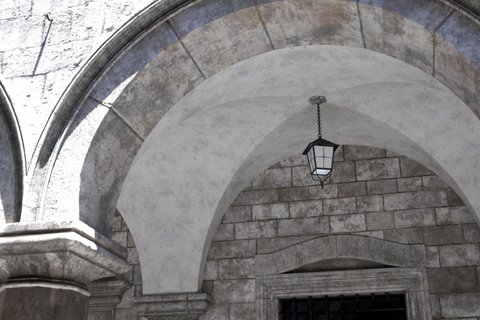
Hint: Slide the zoom to the right end and frame one arch.
Try this lesson in the simulator
Key takeaways
- Short focal length = wide view; long = narrow and enlarged.
- Perspective comes from where you stand, not from the zoom.
Terms in this lesson
- Focal length (초점거리): The lens property, in mm, that sets how wide you see: short is wide, long is narrow and magnified.
- Angle of view (화각): How much of the scene fits in the frame, as an angle. Wider angle shows more.
- Equivalent focal length (환산 초점거리): A focal length converted to the full-frame (36 × 24 mm) sensor that gives the same angle of view: focal length × crop factor.